UNDP, MCTI, and Interantar · 2021
Antarctic Minute and 101 Questions About Polar Regions
cases.contexto
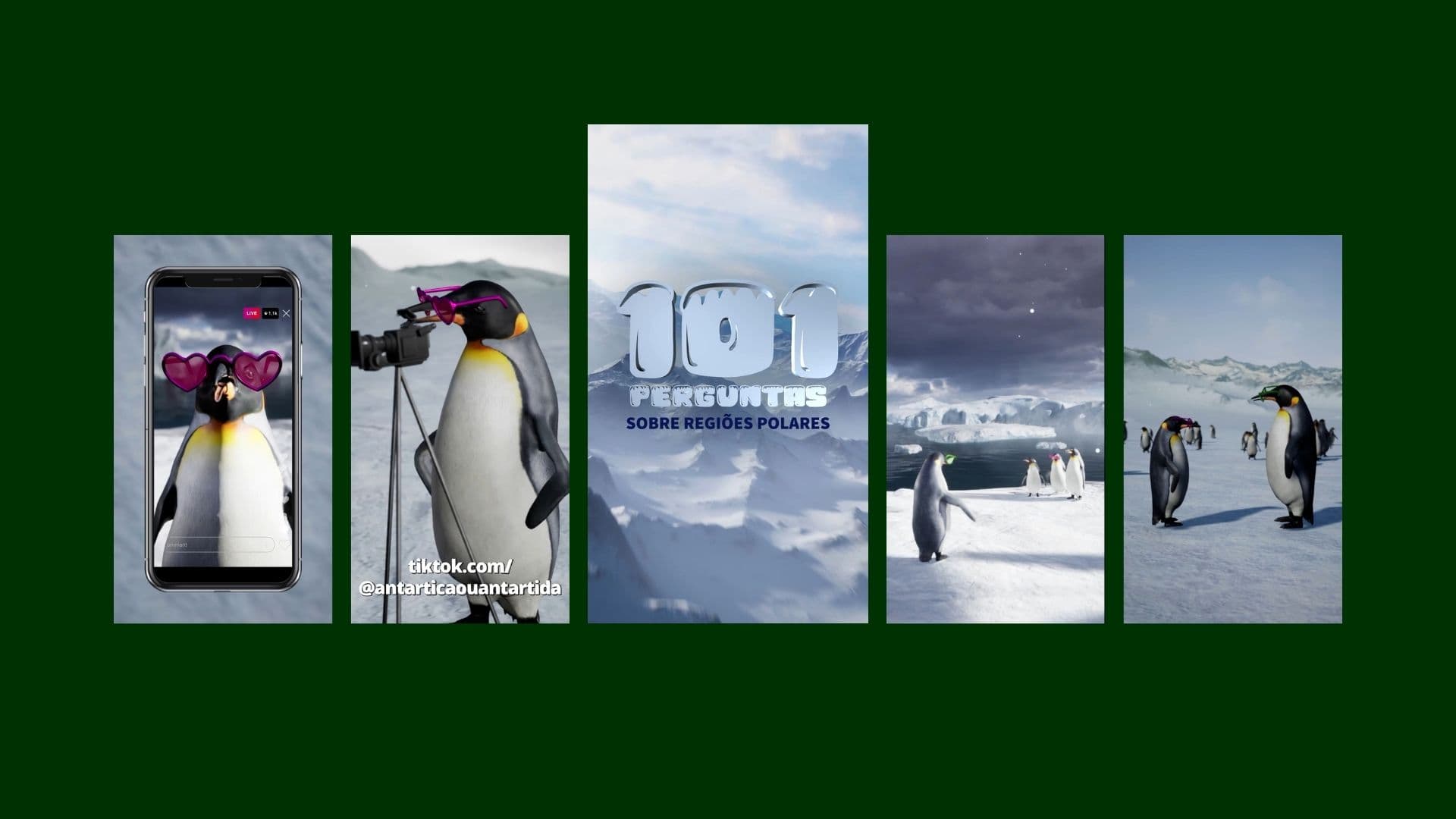
Antarctic Minute and 1001 Questions About Polar Regions are two science communication series produced by Bioma for the United Nations Development Programme (UNDP), the Brazilian Ministry of Science, Technology and Innovation (MCTI), and Interantar. Created to bring Antarctic research closer to young audiences and schools, the productions show how phenomena observed in the polar regions are connected to the climate, the oceans, and the everyday lives of people across the planet. Comprising 10 episodes, Antarctic Minute presents scientific concepts and facts through short, accessible videos designed to spark interest in Antarctica and climate change. 1001 Questions About Polar Regions consists of 45 two-minute episodes starring two penguins who answer questions about Antarctic science and climate change in a fun and engaging way. Developed for distribution on TikTok, the series combines humor, information, and visual resources created specifically for digital platforms. The production used a game engine to generate environments, characters, liquids, and particle simulations in real time. Each penguin was controlled live by a member of the production team, while the characters’ mouth movements were automatically synchronized with the actors’ voices. The background penguin population was controlled using artificial intelligence, based on algorithms developed by Bioma’s team. The project was part of a broader production about Antarctica’s relationship with climate change, which also included scientific videos, experiments, animations, infographics, and content produced in Brazilian Sign Language (Libras), English, and Spanish.
Project Information
Clients: UNDP, MCTI, and Interantar Antarctic Minute: 10 episodes 1001 Questions About Polar Regions: 45 two-minute episodes Distribution: TikTok and digital platforms Year: 2021 Topics: Antarctic science, polar regions, and climate change Technology: Real-time animation, artificial intelligence, automated lip sync, and digital simulations